
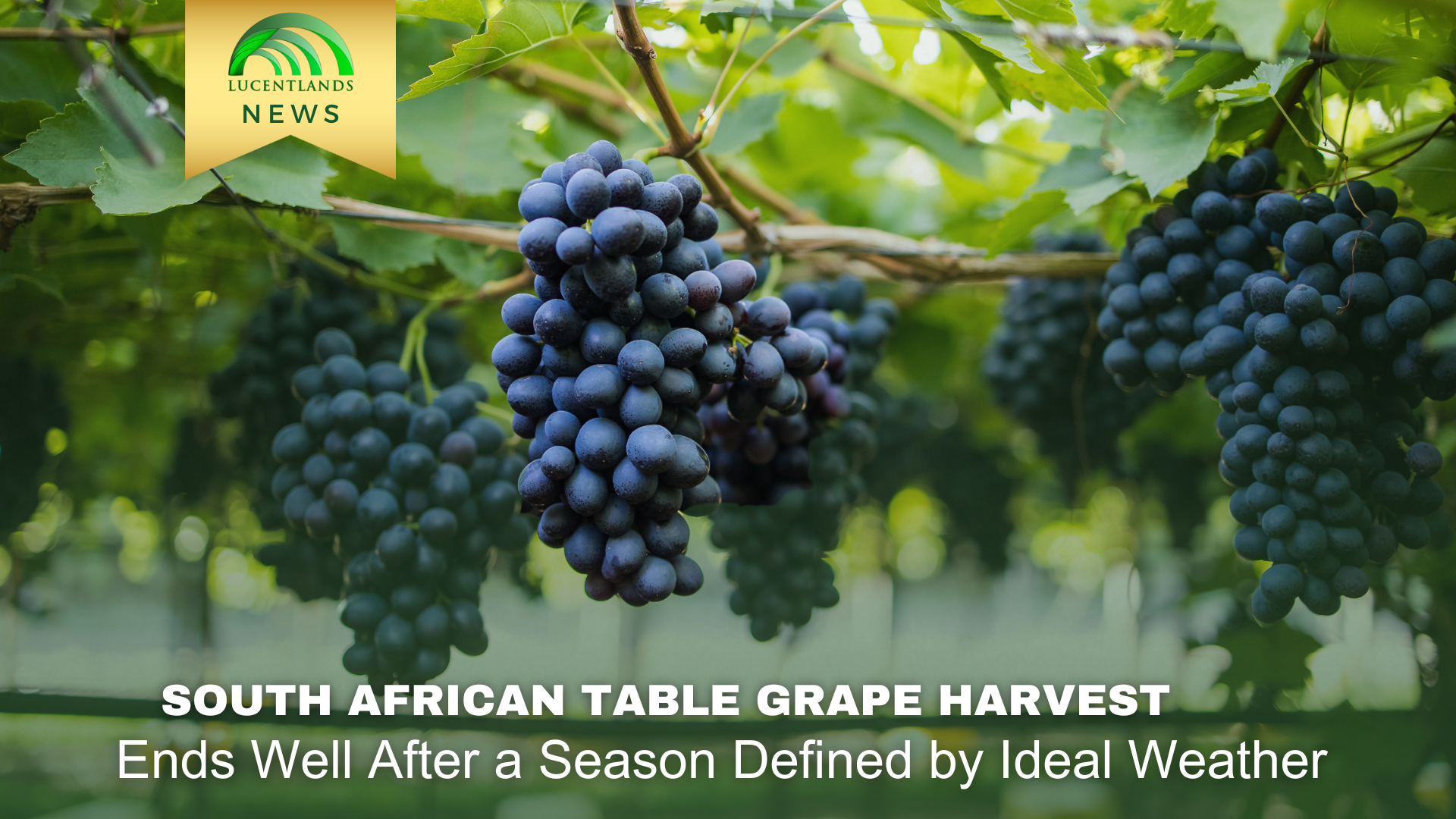
South African table grape industry recorded its largest national harvest ever, packing 78.9 million cartons, a 4% increase on last year, with 77.4 million cartons exported.
South Africa’s 2023/24 table grape season has recently concluded, bringing relief and renewed optimism to the industry which previously has endured two challenging years. Following seasons disrupted by heavy rain, hail, and floods, this year’s harvest benefitted from near-perfect weather during the critical summer ripening period, resulting in an excellent crop.
A major factor behind the success was the prolonged dry and stable conditions experienced across most of the country’s grape-producing regions during ripening and harvest. Table grape growers, who are highly vulnerable to rainfall as grapes approach maturity, were largely spared the damaging effects of moisture. Rain during the ripening stage typically causes berries to swell and split, leading to fungal infections and the loss of entire harvest blocks.
This season, however, growers reported ideal harvest weather, with hot, dry days, low humidity, and minimal rainfall from November through March. This significantly reduced disease pressure and quality risks. As a result, fruit reached full maturity in excellent condition, with consistent colouring across varieties and minimal incidence of cracking or rot. The favourable weather enabled producers to deliver clean, high-quality fruit consistently throughout the season, marking a notable turnaround for the South African table grape industry.
Export Volumes Reach Record Levels
According to the South African Table Grape Industry (SATI), the final total for export volumes is expected to be approximately 73 million cartons (4.5kg carton equivalents), representing a 12% increase compared to the previous 2022/23 season. All five of South Africa’s key production regions contributed to the rebound, with particularly strong volumes from the early Northern Provinces and Orange River regions, previously hardest hit by adverse weather.
By the end of December (week 52), over 20.9 million cartons had been packed for export, a 6% year-on-year increase. Good quality and condition allowed exporters to meet tight retail programs in key markets, including the EU, UK, Middle East, and Southeast Asia. Later regions such as the Berg River and Hex River valleys sustained supply into early April.
In total, the South African table grape industry broke several records this season. Despite a 2% reduction in vineyard area, the country recorded its largest national harvest ever, packing 78.9 million cartons, a 4% increase on last year, with 77.4 million cartons exported, up 5% year-on-year. SATI also reported a new record for weekly inspection volumes during the peak of the season, with more than seven million cartons inspected weekly between weeks two and six.
Inspection volumes have grown by 3.2% over the past decade, and with ongoing vineyard renewal focused on higher-yielding cultivars, yields are expected to rise further in coming years.
Strategic Shifts in Variety Selection
The success of the season was not only due to the weather but also to the ongoing industry-wide strategic shifts in response to changing global demand. South African producers have increasingly aligned their varietal selection with market preferences, focusing on white seedless grapes, which are experiencing strong growth internationally.
Popular varieties such as Autumn Crisp and Sweet Globe featured prominently, while Prime, Early Sweet, and Tawny Seedless were the top exported varieties early in the season.
This trend reflects the industry’s move toward cultivar improvement and consolidation, aimed at improving predictability, postharvest performance, and export competitiveness. With climate stability on their side this year, producers were able to showcase the full potential of these premium varieties.
Logistics Performance Improves Despite Weather Disruptions
Logistical challenges, particularly at Cape Town’s container terminals, remained a key focus area. Although strong winds caused significant delays during February — with 203 hours of activities lost — the overall logistics performance improved compared to previous years. Improvements included the installation of new generators with additional container plug points, more holiday shifts, and the deployment of a predictive logistics model to optimize port operations.
Average productivity at the Cape Town Container Terminal improved, with gross crane moves per hour rising to 13, compared to 10 last year. As a result, the proportion of grapes shipped through Cape Town increased to 90% of total exports, while shipments via alternative ports in the Eastern Cape and Durban decreased. For the first time, South African grapes were shipped from the Namibian port of Walvis Bay and this represented one percent of South Africa’s total table grape exports.
Market Performance and Outlook
By the end of week 8, with 94% of the national crop packed, 71.72 million cartons had been inspected for export, at 4% higher than the same time last year, and 59.81 million cartons had been shipped, up 5%. Around 78% of the volume was destined for the EU and UK markets, which remain crucial to the industry, while shipments to North America showed notable growth, increasing by 27% year-on-year.
Industry leaders emphasized the need for South Africa to maintain its reputation as a reliable table grape supplier to the EU, while also exploring ways to extend the marketing window into North America.
Despite strong winds impacting February operations, the industry’s logistics resilience and continued focus on cultivar development, market diversification, and quality assurance position South Africa strongly for future seasons.
As final shipments make their way to global markets, the 2023/24 season will be remembered as a turning point which has demonstrated the resilience of the South African Table grape industry, as well as its adaptability and renewed global competitiveness.